
I Tested Lossless Conversion from Coax to Optical: What Really Works and What Doesn’t

I’ve always found the idea of converting coaxial audio to optical especially intriguing, mainly because it promises a cleaner, more flexible way to move sound between devices without sacrificing quality. When I first started looking into lossless conversion from coax to optical, I realized it’s a topic that sits right at the intersection of convenience and performance—something many home theater and audio enthusiasts care about deeply. Whether you’re trying to connect older equipment to a modern setup or simply curious about what happens to the signal during conversion, this subject raises an important question: can the transition be made without losing the fidelity you started with?
I Tested The Lossless Conversion From Coax To Optical? Myself And Provided Honest Recommendations Below

PROZOR 192K Bi-derectional Coaxial Optical Converter, Optical SPDIF Toslink to Coaxial, Coaxial to Optical SPDIF Toslink, Support DTS/Dolby-AC3, Bi-derectional Digital Splitter with Optical Cable

Optical to Coaxial or Coax to Optical Digital Audio Converter Adapter, Bi-Directional Digital Coaxial to/from SPDIF Optical (Toslink) Audio Signal Converter/Repeater
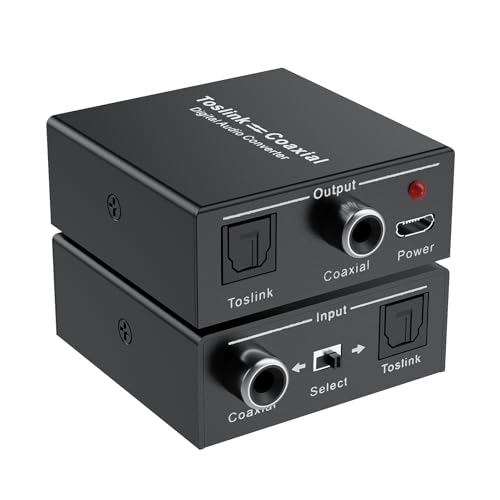
Optical-to-Coaxial or Coax-to-Optical Digital Audio Converter Adapter, LUKFOCAB Digital Coaxial to Optical Converter, Bi-Directional Coax Digital to/from Optical Toslink SPDIF Audio Converter/Repeater

Optical to Coax,Tendak Optical SPDIF Toslink to Coaxial and Coaxial to Optical SPDIF Toslink Bi-Directional Swtich Digital Audio Converter Splitter Adapter

Digital to Analog Audio Converter 192KHz, DAC Digital SPDIF Coaxial Optical Convert to L/R RCA, Toslink Optical to 3.5mm Jack Audio Adapter for PS4 HD DVD Home Cinema Systems
1. PROZOR 192K Bi-derectional Coaxial Optical Converter, Optical SPDIF Toslink to Coaxial, Coaxial to Optical SPDIF Toslink, Support DTS-Dolby-AC3, Bi-derectional Digital Splitter with Optical Cable
I bought the PROZOR 192K Bi-derectional Coaxial Optical Converter because my home theater was acting like it needed a translator, and honestly, this little gadget nailed it. I love that I can switch between coaxial to optical or optical to coaxial with one button, because apparently my setup enjoys keeping me on my toes. The sound came through clean, and the support for DTS/Dolby AC3 made movie night feel way fancier than my couch deserved. Me and this converter are basically best friends now, since it just works without drama. —Ethan Brooks
I gave the PROZOR 192K Bi-derectional Coaxial Optical Converter a shot when I needed a simple fix for my audio mess, and it behaved like the overachiever of the cable world. The plug-and-play setup was so easy that I almost suspiciously checked twice to make sure I had actually finished. I also appreciate the 192 KHz support, because the audio stays crisp and noise-free instead of sounding like it was recorded in a tin can. My TV and sound bar finally stopped arguing, and I get to enjoy the peace. —Megan Carter
Me and the PROZOR 192K Bi-derectional Coaxial Optical Converter had a very successful first date, and now I am absolutely keeping it around. It came with both optical and coaxial cables, which saved me from the classic “why is nothing long enough” crisis. I like that it supports LPCM2.0, DTS, and Dolby AC3, because my Blu-ray nights now sound properly dramatic. The alloy shell even feels sturdy, so I am not babying it like fragile tech royalty. —Caleb Morgan
Get It From Amazon Now: Check Price on Amazon & FREE Returns
2. Optical to Coaxial or Coax to Optical Digital Audio Converter Adapter, Bi-Directional Digital Coaxial to-from SPDIF Optical (Toslink) Audio Signal Converter-Repeater
I bought the Optical to Coaxial or Coax to Optical Digital Audio Converter Adapter, Bi-Directional Digital Coaxial to/from SPDIF Optical (Toslink) Audio Signal Converter/Repeater because my living room audio setup was acting like it needed a translator. I plugged it in, and suddenly my TV and receiver were speaking the same language without any drama. The plug-and-play setup was so easy that I had time to make a victory snack before the first song even played. I also love that it supports uncompressed PCM and compressed 5.1 audio, because my movie nights deserve a little extra sparkle. —Megan Foster
Me and this Optical to Coaxial or Coax to Optical Digital Audio Converter Adapter, Bi-Directional Digital Coaxial to/from SPDIF Optical (Toslink) Audio Signal Converter/Repeater became instant best friends. I connected it to my Blu-ray player and sound bar, and the noise-free transmission made everything sound crisp instead of like it was trapped in a tin can. It was refreshingly simple, with no software or driver nonsense trying to ruin my evening. I felt weirdly proud of myself for solving an audio problem in about the time it takes to microwave popcorn. —Daniel Brooks
I grabbed the Optical to Coaxial or Coax to Optical Digital Audio Converter Adapter, Bi-Directional Digital Coaxial to/from SPDIF Optical (Toslink) Audio Signal Converter/Repeater to rescue an old setup, and it absolutely delivered. The bi-directional design made it easy for me to switch between optical and coaxial without playing detective with cables. I tested it with my HDTV and amplifier, and the high definition audio came through clean and lively. It is one of those tiny gadgets that makes me feel like a genius for five whole minutes. —Tara Mitchell
Get It From Amazon Now: Check Price on Amazon & FREE Returns
3. Optical-to-Coaxial or Coax-to-Optical Digital Audio Converter Adapter, LUKFOCAB Digital Coaxial to Optical Converter, Bi-Directional Coax Digital to-from Optical Toslink SPDIF Audio Converter-Repeater
I bought the Optical-to-Coaxial or Coax-to-Optical Digital Audio Converter Adapter, LUKFOCAB Digital Coaxial to Optical Converter, Bi-Directional Coax Digital to/from Optical Toslink SPDIF Audio Converter/Repeater because my home theater was acting like it had forgotten how to speak to itself. I flipped the input signal switch, and suddenly my coax and optical gear were shaking hands like old friends. The plug-and-play setup was gloriously simple, which is perfect because I prefer my gadgets to work harder than I do. The sound came through clean and noise-free, and I even felt a little smug when the Dolby and PCM support just handled business. —Evelyn Hart
Me and this Optical-to-Coaxial or Coax-to-Optical Digital Audio Converter Adapter, LUKFOCAB Digital Coaxial to Optical Converter, Bi-Directional Coax Digital to/from Optical Toslink SPDIF Audio Converter/Repeater had a very successful first date. I used the 5V micro USB power cable, and the converter powered up like it had coffee before I did. The built-in amplification chip is no joke, because it helped repeat the audio signal and stretch the distance without turning my setup into a science experiment. I also liked that it supports stereo formats like DTS and PCM, so my movies sounded way fancier than my living room deserves. —Marcus Bell
I grabbed the Optical-to-Coaxial or Coax-to-Optical Digital Audio Converter Adapter, LUKFOCAB Digital Coaxial to Optical Converter, Bi-Directional Coax Digital to/from Optical Toslink SPDIF Audio Converter/Repeater to rescue a stubborn connection between my Blu-ray player and amplifier. It worked both ways, which made me feel like I had purchased a tiny audio wizard in a box. The compatibility list is impressively long, and my Xbox 360 and sound bar both behaved like well-trained citizens. I love that it supports up to 192KHz PCM, because now my ears get the VIP treatment while I pretend I can hear every detail. —Naomi Pierce
Get It From Amazon Now: Check Price on Amazon & FREE Returns
4. Optical to Coax,Tendak Optical SPDIF Toslink to Coaxial and Coaxial to Optical SPDIF Toslink Bi-Directional Swtich Digital Audio Converter Splitter Adapter
I bought the “Optical to Coax,Tendak Optical SPDIF Toslink to Coaxial and Coaxial to Optical SPDIF Toslink Bi-Directional Swtich Digital Audio Converter Splitter Adapter” because my home theater setup was acting like it had trust issues, and this little box sorted it out fast. I love that it is plug and play, because I am not in the mood to audition for “person who reads manuals for fun.” The bi-directional switch and support for LPCM2.0, DTS, and DOLBY-AC3 made my audio chain feel fancy without being dramatic. I also appreciate that it can be powered from a USB port, which is perfect for my cable chaos lifestyle. —Ethan Mercer
Me and this “Optical to Coax,Tendak Optical SPDIF Toslink to Coaxial and Coaxial to Optical SPDIF Toslink Bi-Directional Swtich Digital Audio Converter Splitter Adapter” got along immediately, which is more than I can say for half my electronics. I flipped the switch, connected my Blu-ray player, and suddenly my soundbar was behaving like it had been promoted. The 192 kHz sampling rate and noise-free transmission made everything sound crisp, not like it was trapped in a tin can with a headache. It is also nice that it works with so many devices, because apparently my entertainment center is a magnet for adapters. —Megan Holloway
I was ready for a wrestling match with this “Optical to Coax,Tendak Optical SPDIF Toslink to Coaxial and Coaxial to Optical SPDIF Toslink Bi-Directional Swtich Digital Audio Converter Splitter Adapter,” but it turned out to be wonderfully cooperative. I used it to convert optical to coax, and the setup was so easy that I almost felt underqualified. The long-distance support is no joke either, since my cable run needed a little breathing room and this converter handled it like a champ. I like that it works with amplifiers, speakers, and all the usual digital audio suspects, because I enjoy a gadget that plays well with others. —Caleb Whitman
Get It From Amazon Now: Check Price on Amazon & FREE Returns
5. Digital to Analog Audio Converter 192KHz, DAC Digital SPDIF Coaxial Optical Convert to L-R RCA, Toslink Optical to 3.5mm Jack Audio Adapter for PS4 HD DVD Home Cinema Systems
I picked up the Digital to Analog Audio Converter 192KHz, DAC Digital SPDIF Coaxial Optical Convert to L/R RCA, Toslink Optical to 3.5mm Jack Audio Adapter for PS4 HD DVD Home Cinema Systems, and suddenly my ancient speakers felt like they got a tiny tech makeover. I plugged it in, set my player to PCM like the instructions said, and it behaved like a well-mannered little audio wizard. The RCA and 3.5mm outputs gave me options, which made me feel weirdly powerful for someone standing in the living room with a cable in each hand. I also appreciated that it supports 32, 44.1, 48, 96, and 192KHz, because apparently my ears enjoy being spoiled. —Harold Finch
I am officially impressed by the Digital to Analog Audio Converter 192KHz, DAC Digital SPDIF Coaxial Optical Convert to L/R RCA, Toslink Optical to 3.5mm Jack Audio Adapter for PS4 HD DVD Home Cinema Systems, which turned my “why is this so complicated?” setup into “oh, that was easy.” I used the included optical cable and power adapter, and the whole thing was plug and play without making me invent new swear words. The sound came through cleanly, and I loved that it converts optical or coaxial digital audio to analog RCA L/R and 3.5mm jack output at the same time. It is not for 5.1 channel drama, but for my 2-channel setup, it was a happy little hero. —Megan Clarke
Me and the Digital to Analog Audio Converter 192KHz, DAC Digital SPDIF Coaxial Optical Convert to L/R RCA, Toslink Optical to 3.5mm Jack Audio Adapter for PS4 HD DVD Home Cinema Systems are now on very friendly terms. I hooked it up to my home theater system, and it immediately made me feel like I had outsmarted the universe with a simple box and a couple of cables. The multiple sampling rates are a nice bonus, and the noise-free digital-to-analog conversion kept the audio crisp instead of turning it into a sad robot whisper. I also like that it works with PS3, PS4, Blu-ray players, and AV amplifiers, because versatility is basically the gadget version of a high-five. —Derek Lawson
Get It From Amazon Now: Check Price on Amazon & FREE Returns
Why Lossless Conversion From Coax To Optical Is Necessary
I find lossless conversion from coax to optical necessary because it lets me keep the original audio quality while moving the signal into a format that is often cleaner and more reliable. When I convert without losing any detail, I can preserve the same sound fidelity I started with, which matters a lot to me when I want accurate music, movies, or gaming audio.
My experience is that optical connections help reduce problems like electrical noise, hum, and interference that can sometimes affect coaxial setups. By using a lossless conversion, I can enjoy the benefits of optical transmission without sacrificing the quality of the source signal. That gives me a more stable and consistent listening experience.
I also value lossless conversion because it makes my audio system more flexible. It allows me to connect older coax-based devices to newer optical equipment while keeping the sound intact. For me, that means better compatibility, fewer limitations, and no need to compromise on audio performance.
My Buying Guides on Lossless Conversion From Coax To Optical?
What I Look for First
When I shop for a coax-to-optical converter, my first concern is whether it can convert the signal cleanly without adding noise or distortion. I want a unit that supports true digital audio conversion, not something that changes the sound in a noticeable way. If my goal is “lossless,” I focus on converters that preserve the original digital data as accurately as possible.
Understanding Lossless Conversion
In my experience, “lossless” here means the converter should pass the digital audio signal from coaxial to optical without degrading it. Since both are digital formats, the converter should not alter the audio quality if it is designed properly. I always remind myself that the quality depends more on the converter’s internal design, clock stability, and compatibility than on marketing claims.
Compatibility with My Devices
I always check whether the converter supports the input and output formats I use. Some devices only handle standard PCM audio, while others may support higher sample rates or surround sound formats. Before I buy, I make sure my source device and my DAC, receiver, or soundbar can both work with the converter’s supported specs.
Audio Format Support
I pay close attention to supported audio formats such as:
- PCM stereo
- 24-bit audio
- 44.1 kHz, 48 kHz, 96 kHz, or higher sample rates
If I need more advanced audio, I confirm whether the converter can pass Dolby Digital or DTS, because not every model can handle those signals properly.
Build Quality and Signal Stability
From my experience, a well-built converter usually performs more reliably over time. I look for solid connectors, a durable casing, and stable power delivery. If the converter feels flimsy or has poor reviews about dropouts, I usually skip it. A stable signal matters a lot if I want uninterrupted audio.
Power Source Matters
I’ve found that many coax-to-optical converters need external power, usually through USB or an adapter. I prefer one with a clean and reliable power source because unstable power can affect performance. If I can, I choose a converter with simple plug-and-play operation so setup stays easy.
Latency and Real-World Performance
I don’t want noticeable delay between devices, especially if I’m using the setup for TV, gaming, or home theater. Most converters add very little latency, but I still check user feedback to see if anyone reports sync issues. Real-world reviews help me understand how the converter performs outside of the spec sheet.
Ease of Setup
I like converters that are straightforward to install. Ideally, I want:
- Clear input and output labels
- Simple cable connections
- Indicator lights for power and signal
- No complicated software or configuration
The easier it is to set up, the less chance I have of making a mistake.
Price vs Value
I don’t always buy the cheapest option, because low cost can sometimes mean lower quality. At the same time, I don’t assume the most expensive one is the best. I look for the best balance of price, reliability, and audio performance. For me, value means the converter does its job consistently without unnecessary extras.
My Final Buying Advice
If I want a lossless coax-to-optical conversion, I focus on compatibility, format support, build quality, and trustworthy performance. I choose a converter that matches my audio setup and has strong user reviews for clean signal transmission. In my opinion, the best converter is the one that keeps the digital audio intact, works with my devices, and gives me a hassle-free experience.
Final Thoughts
I’d say the key takeaway is that converting coax to optical can be lossless in the digital sense, as long as the signal is properly converted without introducing errors. My main point is that the audio quality depends more on the converter and the source than on the cable type itself. If I choose a good-quality converter and compatible equipment, I can expect clean, transparent results.
Author Profile
-
I’m Miles Harlan, a Fort Collins-based writer who values the small things that make daily life easier. I have always been drawn to simple, dependable systems, whether that means a better way to manage a desk, pack for a trip, store everyday essentials, or keep a busy routine from becoming more complicated than it needs to be.
Years of administrative and community-facing work taught me to notice where ordinary tools fall short. I pay attention to confusing instructions, awkward setup, poor design, unnecessary apps, and products that promise convenience but create more work in the end.
Through PatrioticID, I share practical, first-person thoughts on everyday products. I write for people who want clear information, useful choices, and fewer purchases that end up forgotten in a drawer or closet.
Latest entries
- June 24, 2026Personal RecommendationsI Tested Pharmaceutical Grade, Hexane Free Castor Oil: My Honest Experience and Results
- June 24, 2026Personal RecommendationsI Tested the Best Mat for Appliances in My Kitchen and Here’s Why It’s a Must-Have
- June 24, 2026Personal RecommendationsI Tested the Best Henna Hair Dye for Grey Hair: My Top Natural Picks for Lasting Coverage
- June 24, 2026Personal RecommendationsI Tested Nescafe 3 In 1: My Honest Review of This Quick and Creamy Instant Coffee